Kalyan-Dombivli residents caught smuggling exotic animals at Bengaluru airport
Buyers are no longer super-rich. In fact, they comprise every citizen who is being influenced by the glamourisation of owning exotic animals via social media
 Amritpal Singh Sanhotra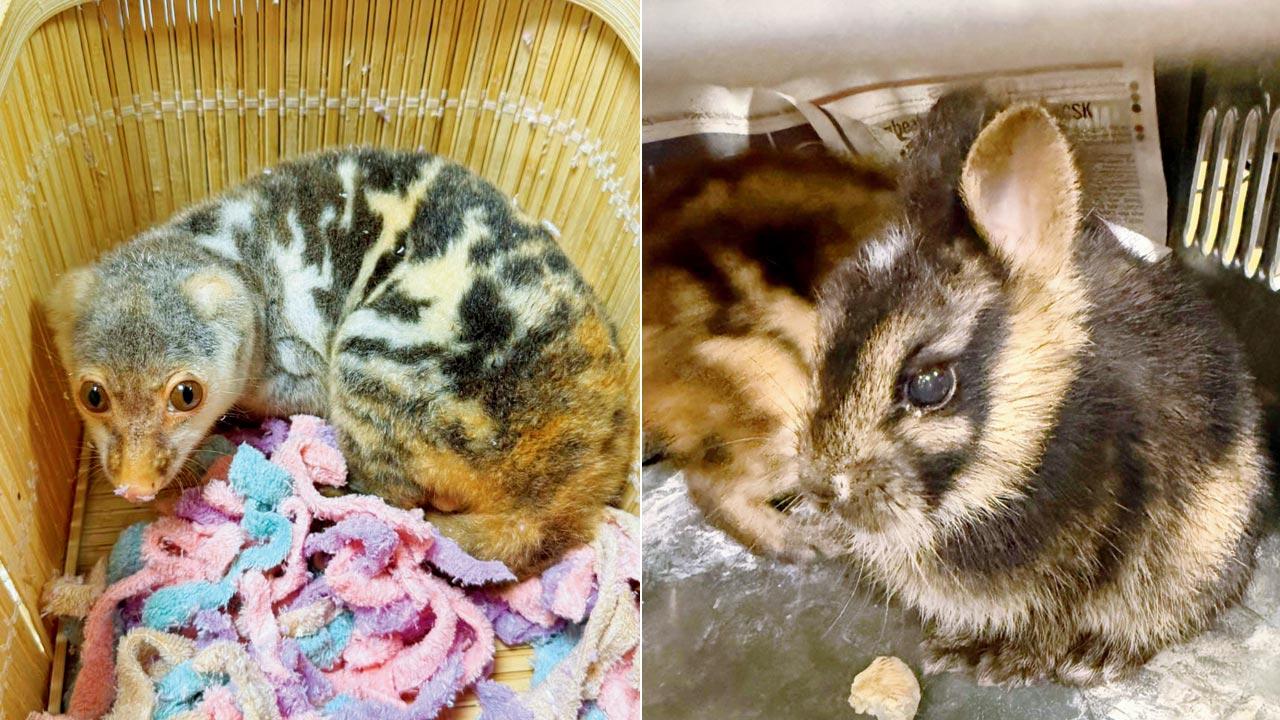
Following the arrest of three Kalyan–Dombivli residents at Bengaluru airport for smuggling exotic animals in a suitcase, conservationists are urging the forest department to investigate the area as a possible hub for wildlife trafficking. Sources indicate that officials are now searching for evidence of a larger trafficking network operating out of Kalyan-Dombivli.
On January 16, there was an attempted import of live exotic animals from Bangkok to Bengaluru through Indigo Airlines Flight.
The Air Intelligence Unit of Customs at Kempegowda International Airport, Bengaluru, had intercepted three passengers who arrived from Bangkok, Thailand, to Bengaluru through Indigo Airlines Flight No 6E- 1056 on January 16. When the authorities checked the baggage of the three people, live exotic pets were seized from their bags.
The accused are from Kalyan Dombivli
The three accused were identified as Aryan Sudan Gite(21) a resident of Ashok nagar in Dombivli West, Alsana Aslam Shaikh , aged 26 Years, who is the resident of Mhatre Chal kalyan West and Zareen Aslam Shaikh(46) of the same Kalyan west area.
What was seized?
Exotic animals were seized at Kempegowda International Airport, Bengaluru, from three passengers arriving from Bangkok. The seizure included two squirrel monkeys (one dead), five green/yellow iguanas (all alive), eleven albino iguanas (four dead), five blue iguanas (all alive), two Abert’s squirrels (one dead), two Patagonian hares (one dead), and eight albino sugar gliders, of which seven were found dead. The live animals were handed over to wildlife authorities.
The Rhinoceros rat snake found in Vietnam and southern China; (right) Brown Basilisk lizard is native of tropical lowlands of Mexico, Central America, and northwestern Colombia. Representational pics/Special Arrangement
The exotic wildlife trade
If you have been paying attention to the news, you will notice that incidents of illegal wildlife trafficking, as well as trade in exotic species, are growing more frequent, and the network for the same has only grown bigger. It is not limited to the usual suspects, like the super-rich as buyers and regular importers like breeders/traders, or sellers, as seen in previous years.
The new customer cuts across economic classes
Pawan Sharma, Advocate and wildlife conservationist, Founder & President RAWW (Resqink Association for Wildlife Welfare) which has been assisting the state and centre in countering illegal wildlife trafficking since more than a decade said, “Kalyan Dombivali has been in the spotlight in the past as well when a baby Orangutan along with many snakes, lizards, tortoise and turtles were recovered from the house of a pet trader who earlier operated from Mumbai and had shifted base to KDMC limits. The location as a base seems to be of more strategic value, and the customer base has been expanding across the MMR — and not limited to Mumbai city alone,” he said. “The forest department and wildlife crime control bureau should investigate the Bangalore case in parallel and check the background and link of the three arrested, who are also residents of Kalyan-Dombivli,” he added.
Sharma told Sunday mid-day that the interceptions are being noticed in areas that are otherwise considered highly secured. Airports, for example, have become the scene of intel-based raids and seizures.
“Just imagine what would be coming in from the sea route and the roadways across borders unknown and unchecked. A national counter-trafficking team, including multiple agencies and multi-jurisdictional powers, is the need of the hour. This is not and cannot just be the job of the Forest Department, Police, or Customs, etc., as each department is already overburdened and understaffed,” added Sharma.
Social media posts where people show off “owning” an exotic animal are also one of the major reasons that have influenced this spike in demand among everyday Indians, for whom this was earlier an indulgence of the affluent. The dark web has also provided a new trade channel, say officials involved in the rescues and seizures.
Experts believe that not only traditional hunters and poachers but also a new wave of buyers and sellers, probably lured with a big payout, are involved in the smuggling. One can come to this conclusion as most who are caught seem to be first-timers, making the organised syndicate almost untraceable and therefore untouched.
“The concept of exotic wildlife as pets has penetrated into the system so deeply and is spreading. The rich, elite, and influential people are seen practising and supporting this, including top business tycoons, actors, and politicians. The concept of regulatory trade through CITES has been exploited and misused to import and export several species of flora and fauna across the globe, and the unseen negative impact is immeasurable and equally ignored,” said Sharma. The situation seems to be right out of a crazy millionaire movie, “Private collection individuals and private zoos, both regulated and illegal in the name of exotic wildlife trade, revenue generation models in the name of rescue and rehabilitation, or spreading awareness and information, are falsely shown in a positive light without understanding the core ethics of wildlife conservation. What we see in the open is just the teaser, and the actual script is beyond imagination,” added Sharma
Rohit Mohite from the Thane-based NGO-WWA, echoes Sharma’s sentiments of cross-departmental collaboration. “There is a need for enhanced coordination and intelligence-sharing among wildlife conservation authorities and enforcement agencies to assess whether certain pockets of the Mumbai Metropolitan Region, including Kalyan-Dombivli, are being misused as transit or operational points in the illegal exotic pet trade,” said Mohite. Mapping out the route being used, he explains, “Preliminary inputs suggest possible movement routes passing through Kalyan–Dombivli and Mumbra, with linkages extending to cities such as Pune, Thane, Palghar, and Nashik, indicating the likelihood of a wider inter-district supply chain that warrants close monitoring and timely action.”
What do Forest Dept officials say
A forest official, on condition of anonymity, said, “Preliminary observations suggest that areas such as Kalyan–Dombivli and Mumbra may be points from where exotic wildlife animals are supplied to parts of the Mumbai Metropolitan Region and adjoining districts, including Thane, Pune, Nashik, and Palghar. Notably, the three individuals recently arrested in Bengaluru for possession of exotic wildlife pets are residents of Kalyan–Dombivli. Authorities are examining whether they have a prior history of involvement and possible links to a larger network.”
An official from the Wildlife Crime Control Bureau (WCCB) said they have received details of the three Maharashtra-based accused who were apprehended at Bengaluru airport with exotic pets, and efforts are underway to gather further information. “We will also keep a close watch on those who have been arrested,” the official added.
What happens to seized species?
Under existing Animal Quarantine & Certification Services (AQCS) and Indian Customs rules, these animals must be sent back immediately to their country of origin, with intimation to all relevant authorities there. The transport of animals and birds by air is already governed under Aeronautical Information Circular (AIC) 9 of 1985.
The Dombivli case
In November 2024, the Forest Department conducted a raid in Dombivli, during which orangutans and other wild species were rescued.
Pricing of exotic animals
Rs 10K-R15K
Squirrel monkey
Rs 10K-R20K
Blue iguanas
Rs 10K-R15K
Green yellow iguana pair
Did you know?
. As per the provisions of the Export Import(EXIM) policy, import of live animals listed under the Wild Life (Protection) Act, 1972, and listed under the Convention on International Trade in Endangered Species of Wild Fauna and Flora (CITES) are strictly regulated.
. The import of such animals without a valid CITES Export Permit, a Directorate General of Foreign Trade (DGFT) license, NOCs from the Chief Wildlife Warden, Ministry of Environment, Forest and Climate Change (MOEF&CC), and an Animal Quarantine Certificate is prohibited.
. Furthermore, the commercial trade of species listed in CITES Appendix-l and Schedule-IV of the Wild Life (Protection) ACt, 1972, is also prohibited.